Showing posts with label oxygen. Show all posts

Wednesday, October 22, 2014

Pulmonary Fibrosis and Panic Attacks

Over the years, I have heard many people with Pulmonary Fibrosis mention that they experience severe panic attacks.  It seems understandable that this would occur because many have difficulty breathing as part of their illness.  When I Google or look up panic attacks, many of the writings are geared toward people who generally have these experiences, but I cannot find much in writing or resources that specifically deal with this occurring while on oxygen and having a terminal illness.  

Though panic attacks can be severely debilitating, it seems that much of the literature indicates to face the fears you have and realize that the percentage of them actually coming true is very low.  With Pulmonary Fibrosis, I think this does not apply, as often the source of the panic has to do with the fear of not getting enough air, which is a very real scenario to PF patients.

I remember my husband experiencing quite a few of these attacks.  Some where quite severe.  He would flail his arms in desperation of getting more O2, but in reality, he was pulling the O2 out of his nose and knocking down canisters.  Another time he was so desperate for more air, that although he had a portable O2 container turned on and in his noes, that he picked up the portable and began trying to suck air out of the handle itself.  It was very heartbreaking to see.

As a caregiver going through this with him, I had to learn to keep calm and be very deliberate in my voice and actions.  No rushing, although he was in panic mode, I could not allow myself to rush about the room. Why?  If his surroundings were chaotic during these episodes, it only made the situation worse. If he could not be calm, then I had to for the both of us.  

Touching him during this time had to be thought out.  Rather than rubbing his back, I would place my palm flat on his back and hold it still.  Everything had to come down a notch, including my voice.  Speaking in a low, soft tone can be more helpful rather than an elevated voice.    

Helping him to focus assisted in bringing down the heightened nature of a panic attack.  If he was scared he didn't have enough air, I would put the pulse-oximeter onto his finger for both of us to check it.  Getting him to look at it helped gain focus.  If his SAT's were low, I turned up his O2 and gently let him know they will start rising soon.  Let's watch them rise together.  


These attacks sometimes came during a coughing episode, or would bring a coughing episode on.  By the time they passed, all of his energy was spent.  It took so much out of him to go through this.  I wanted to minimize this happening and looked at the different scenarios in which they occurred in the past.  I tried to notice patterns.


I noticed that many of them occurred before his showers.  Showering becomes a difficult task for someone with PF.  The moisture and steam in the air, the use of your arms to lather, the slipperiness of the tub, the water on the floor, the energy used to dry off, all become monumental.  There was no such thing as a quick shower anymore.  Understanding that and blocking out an appropriate amount of time eased the task.  As a caregiver, making sure everything was ready for him also helped.

We were provided a slew of drugs while he was on hospice. One of them was a liquid dose of Larazapam.  This was specifically provided to ease anxiety.  In this form, it did help but was something that worked in only the short-term and the dose might be given several times a day, depending on what kind of a day he was having.  At first, when all this was new to us, we administered a dose during his panic attacks as a way to help him calm down.  As time passed and we recognized the patterns of his panic attacks, we realized that the best time for him to take this was prior to his shower.  Before he felt the anxiety.

Everything we did had to do with preventing them in the first place.  Thinking ahead of any given situation, allowing the proper amount of time and preparing in advance seemed to help the most.  As he changed, we were flexible enough to change the preparations to assist his needs.

Everybody is different.  One thing I noticed and found rather unexpected, was that Morphine worked the opposite than what we thought it would do.  We thought it would help with his pains and help him to relax.  It did help with pain, although I noticed a pattern with that as well.  His form was a liquid Morphine taken orally.  At first administration, he would become somewhat sleepy, so we found that, for him, taking it after a shower and lunch would allow for a nice little nap.  I noticed that after an hour or two, he would become restless in his sleep and literally wake up in a panic.  While he was at this period, he suddenly felt he needed 5 things all at once and at first, not seeing the pattern of his reaction to this drug, I would run around the room trying to satisfy his every need.  It took a little time to recognize this pattern and having something soothing for him when he awoke, such as a cup of tea, seemed to decrease this.  

I have also read that certain foods may increase the possibility of panic attacks.  Too much sugar or caffeine might bring them on more frequently.  

Much of this is written from a caregiver's standpoint, yet, there are many people with PF who experience this and do not have any assistance.  This can be very frightening.  It might be a good idea to visit with your doctor to discuss these attacks if they are too frequent, or preventing you from daily enjoyment.  My husband was not on an anti-depressant, although some people say that this has helped them a great deal. Having a phone near-by or discussing this with your friends or family may give you additional support.  Of course, learning to change your focus from what is causing the panic to something else would help, but is one of the hardest things to do.  

Here are some links that may provide further insight (I will put a question mark after each topic, because not all of these will be helpful to everyone, but, maybe there is one for you.)  Be sure to speak with your doctor regarding any questions you may have before starting medications or natural supplements.  

Meditation? 


Tea?


Points of Focus? 


Diet?  


Pharmacy?  

Drug options for treating Anxiety/ Depression- http://www.webmd.com/anxiety-panic/

Herbal?


Peer Support?  

Pulmonary Fibrosis Foundation Support Groups-  http://www.pulmonaryfibrosis.org/life-with-pf/support-groups


Sunday, September 28, 2014

Information on Managing your symptoms of Idiopathic Pulmonary Fibrosis~ via; Lungs and You

This article is via; Lungs and You, please check out their website for more great information at:  www.lungsandyou.com

There are no FDA-approved medicines that treat IPF. However there is a good deal of research being performed and several clinical trials are underway to investigate potential treatments for IPF. These treatments are experimental and the impact they have on the course of IPF is currently being studied.
Despite the lack of medicines approved to treat IPF, there are still things you can do to help manage IPF symptoms and try to sustain your ability to perform daily activities for as long as possible.
The approaches used to manage the symptoms of IPF are designed to meet each patient’s unique needs. Every person’s medical history is different. In addition, people with IPF frequently suffer from other medical conditions. These other conditions may have an impact on the course of IPF (See "Managing other conditions" below.)
It’s also important to remember that each patient experiences IPF differently, and while some people with IPF don’t live long after getting their diagnosis, others may live longer than the often-quoted averages. Working together, you and your doctor can develop a plan to help you manage your symptoms in an effort to sustain your ability to participate in daily activities for as long as possible. Common approaches to managing IPF symptoms are listed below.

Summary of options for managing IPF symptoms

Oxygen Therapy
Pulmonary RehabilitationIncludes a range of conditioning and breathing exercises
The goal is to help patients function to the best of their ability
Oxygen Therapy
Oxygen TherapyRecommended for patients who have low oxygen levels
May help reduce breathlessness, enabling the patient to take part in pulmonary rehab exercises
Lung transplant
Lung TransplantCan improve both life expectancy and ability to participate in daily activities
Reserved for patients who have no other significant health problems, such as cancer; heart, liver, or kidney disease; or chronic infection, among others
IPF is now the leading reason for lung transplantation in the US
Lung transplantation has significant risks, including illness or fatality from the surgical procedure itself, infection, and cancer due to the use of drugs that suppress the immune system; you should discuss these risks with your doctor before considering a lung transplant
Clinical trials
Clinical TrialsTaking part in clinical trials may be an option for some people with IPF
Talk with your healthcare team about your condition and your options

Managing other conditions

As mentioned above, it is common for people with IPF to also have other medical conditions (called “comorbidities”). These may include obesity, diabetes, pulmonary hypertension, obstructive sleep apnea, coronary artery disease, and emphysema.
These conditions will often require their own treatments and medicines. They may even have an impact on the course of IPF. Remember to always take your medicines as prescribed by your doctor.
If you have any questions about other health conditions you have, or the medicines you are taking for them, be sure to talk to your doctor.

Thursday, September 25, 2014

Pulmonary Function Test (PFT)


Many people diagnosed with lung restricted diseases are referred to take a Pulmonary Function Test (PFT). National Jewish Health gives an over-all description of what the test will entail.

Here is also a link that will help you understand the results of your PFT:


Monday, September 15, 2014

More of us need to know about pulmonary fibrosis~ via; Letters to the Editor, AZ Central


September is Global Pulmonary Fibrosis Awareness Month.
It seems every dread disease has a special month — and pulmonary fibrosis is no different. Some stats about this disease:
• This disease is 100 percent fatal.
• Each year, 40,000 will die from PF, about the same number of fatalities as from breast cancer.
• There is no known cause or treatment, and the disease is relentlessly progressive; average lifespan from time of diagnosis is two to five years.
• PF patients gradually lose the ability to process oxygen as their lungs fill with scar tissue and become stiff. Oxygen can't pass into the blood.
• Four times as many people have PF as ALS or cystic fibrosis.
• Since 1999, the number of patients with PF increased by 156 percent, to more than 128,000, and more than 50 percent of the cases are misdiagnosed for a year or more.
• A lung transplant is the only option to extend life, but 50 percent of those on the list will die before receiving a transplant.
• There is only one PF support group in Phoenix and the surrounding area.
• St. Joseph's Hospital and Medical Center is doing research on medications for PF.
My husband was recently diagnosed with PF.
More information is available at pulmonaryfibrosis.org.
— Madeline Wollmer,
Laveen

Wednesday, June 25, 2014

So Beautiful~ Written By: Cathy Lewis


So so beautiful, the Poem~ 
I too have IPF, 
In the Hospital since march 2014, 
Diagnose 2012,
Always unaware, 
Always losing the battle, 
To continue in my effortlessly wandering journeys, 
That's what this disease do, 
It takes away the will the breathe,
To take another step effortlessly,  
On a ventilator creating 
And remembering,
As I always do,
No longer in the wind of nature's bliss,
But, now on the ventilator holding on to the blessings, 
and God's will.
~Cathy Lewis

*********From time to time, I am lucky enough to receive mail from readers. I read Cathy's comment, in regard to another poem written on the blog and felt that her comment, actually read as a poem. Eloquent and So Beautiful was her comment that I asked if I could use it on my blog. Cathy, Thank You for allowing me to publish your note and know that we all keep you in our thoughts and hearts. ~With Love, ~Breathing

Thursday, June 19, 2014

Every Breath Counts~ Idiopathic Pulmonary Fibrosis- Discovery Channel- June 21st- 8:00 am ET/PT


Finally, an opportunity for others to learn about this disease.  Despite the many lives it affects, it is still relatively unknown.  People who suffer from this disease, as well as their family members, desperately want to live.  Many also want awareness and general understanding of what they have to go through. In this documentary is a little piece of all of our stories. 

I lost my beautiful husband to this disease and as I watched the trailer to this film, for a brief moment, I felt as though I am watching something that is affecting someone else.  It wasn't us- this wasn't our family....  But, it was us.  This was our family's story.  My family lost a father and husband to this disease and I can never hold his hand in mine again.   

When I think about the tremendous impact of this experience being multiplied by all the others who are still being diagnosed, I know that every bit of awareness is necessary.  Even if you have never heard of IPF, do try to watch this and discuss it with a friend. You never know how that one action might help to find a cure.  

With Love,

 ~Breathing

To watch a preview, Click:  http://everybreathcountsfilm.com/

Sunday, March 30, 2014

And the dinner bell rings~

I had another blog at one time.  It was fun for me to write and take pictures.  The blog was a mix of Diners, Drive-Ins and Dives, with a bit of homesteading and frugal ideas, along with a good dose of road trips and reviews.  I would often grab a plate of whatever was for dinner and take it to wherever the good lighting was in order to take a picture of it. Meanwhile the family would moan and groan sitting around the table as their food got cold while I did this.  Once back at the table, we would all say a prayer of gratefulness for the food that was before us and dig in.  Our family always sat at the table together and as I watched my husband and children attack the food, I felt a sense of accomplishment and worthiness.  I had prepared something that made them feel good, that made them feel loved.

When my husband was diagnosed with Pulmonary Fibrosis, it became more difficult for him to eat. With oxygen blowing in his nose and struggling for every breath, eating became more of a challenge. For those who do not have this disease it might be hard to imagine how eating can become a workout. But, it was for him.  Lifting the fork to the mouth, then the food entering the mouth and the chewing was a great task because he also needed his mouth to breath.  It was almost as though food in the mouth was cutting off another part of his air supply.  My husband lost weight even though he was eating regular meals and the doctors indicated that he was burning more calories in the action of eating than he was actually taking in.  In addition, the fabulous and mouth watering seasoning that made my meals so rich and delicious, was also affecting his digestion.  Often, he would struggle with acid-reflux after a meal and would have to stay in the sitting up position for hours while trying to digest.  

I knew that my cooking had to change.  It would be better for my husband to eat more soft foods that do not require a lot of chewing.  He should eat small portions more frequently throughout the day, rather than 3 regular meals.  The food should be more bland as to not give his digestive system such a challenge. This might seem like an easy transition to make although there were many factors that came into this change. I had a family to feed and the other members of the family did not have the same issue that my husband did.  I also had placed an emotional value to the meals I made and believed that when I cooked for my family it made them feel loved. Even, health-wise, I believed certain meals helped to heal.  We have heard the term Chicken Soup for the Soul, which indicates that Chicken Soup is soothing and healing.  I also associated food as comfort, how many times had I downed a pint of Rocky Road ice cream after a bad breakup?

There are some with this disease that also believe that certain foods exacerbates the occurrence of inflammation within the lungs that cause the scaring of the lungs.  That too many carbohydrates, the eating of processed foods is what makes this disease progress.  There is not a lot of data to validate this idea as each individual may have different triggers to the progression of Pulmonary Fibrosis, although personally, I think there may be some validity to this for some; as a form of trying to slow the disease and if it is implemented early enough within the onset.  

In my husband's case, the disease was so aggressive that he passed away a little over a year from his diagnosis and during that time, there came two points that he didn't want to eat:  The first point was what I am describing above, that he was very much alive and wanted to live, although eating became such a task that it no longer had much appeal.  The second point, was in the very last stage of his illness and is also a very natural state of dying. In addressing the first stage I had to be creative in finding easy to eat foods that did not cause him so much discomfort.  And I also had to realize that my home cooking wasn't the cure for his ailment.  These are some things that I came up with....

Whey Protein Shakes:   A scoop of Whey Protein blended with one Banana and 1 1/2 cups of milk or water.  I served it in a glass with a spoon, as it was impossible for him to use a straw. 

Oatmeal:  What a great way to get protein and nutrients and it can be made as thick or thin as desired.

Soups:  He enjoyed many types of 'creamed' soups such as cream of chicken, cream of broccoli.  I think it gave him that satisfied feeling of a home cooked meal.  He also became introduced to 'Miso' soup and loved it very much.  I would buy packages of Nori, which is dried and pressed seaweed, found in the Asian section of the supermarket.  I  cut snippets of Nori into his soup.  It becomes very soft and can be swallowed without chewing.  

Applesauce:  He loved the feeling of cool applesauce in his mouth and throat.  I would take zucchini and other vegetables, fully cook them until they are very soft, and blend them into the applesauce.  Many times he did not know the vegetables were in there, until I was so proud of the fact I was sneaking them in this way that I had to tell him.  He thought it was great!

Yogurt:  My husband always hated yogurt and would never try a spoonful of yogurt the whole time we were married.  When he got sick and it was hard for him to eat I begged him to try some.  He did and literally after the first spoonful he said yes he would like yogurt more often.  It was at the end of his life that he became a big yogurt fan.  I think it really soothed his sore throat and was nice and sweet.  It also helped his digestive system quite a bit.

Rice Pudding:  He just loved my rice pudding, plain and simple!  There are also easy recipes that include instant rice.  He also enjoyed puddings from the store as a dessert.

Instant Mashed Potatoes:  I normally used regular potatoes for this although as my role of a caregiver progressed as well as a mother and combined with working out of the home, my time became limited.  Instant mashed potatoes is a lifesaver.  It can be added with chicken broth to become a potato soup or it can be served as mashed potatoes with a bit of gravy or butter.

Corn Meal:  I would take two cups of milk and add it with chicken stock, a little bit of butter and let that come to a nice simmer.  Then slowly add the corn meal a little at a time, reduce the heat to low and stir until it become the thickness of a soft Polenta.  I then placed a spoonful into the center of a bowl of soup.  It has a comforting feeling to eat this and helps with nutrients.

Eggs:  Scrambled eggs or even a quiche with very soft, cooked vegetables is delicious and required very little chewing for him.

Crackers and bread:  These would be served with soups for dipping as they become very soft and offer more calories for someone drastically losing weight.

Pedialyte:  This was a great way for my husband to receive electrolytes, which helps replenish the body to proper hydration.  We would buy a bottle of this and add 1/3 to every glass of water.  

Cream of Wheat:  A nice alternative for breakfast.

Rice Cereal found in Baby Food Section:  I did find myself in the baby food section of the store searching for more ideas.  This depressed me a great deal to know I was shopping for my husband.  But, the reward was I remembered that I used Rice Cereal found in that section when my children were babies.  I often added a couple spoonfuls of it into their soft foods.  I did the same with my husband.  It can be added to the soups or applesauce, pretty much anything.

Herbal Tea:  My husband became a great tea drinker at this stage.  He loved blueberry tea, that was his favourite.  It was soothing on his throat, helped to eliminate mucus and eased coughing.  

These are some of the things we did to help assist my husband in his eating.  I had to understand that as his personal chef ;) less was more.  As a family we all had to adjust and more often than not we all had separate, individual meals at this point.  I found myself buying easy things for the rest of us, such as sandwich meats and more soup.  Many of the items above can be made ahead of time, or quickly. As things progressed of course the menu changed even more, although at this point, the items above were a big help to keep my husband eating and enjoying his meals without so much distress.  I hope it helps you if you are dealing with this situation and if you have any further ideas that might help others, feel free to add them to the comments.  With Love, ~Breathing

Monday, January 6, 2014

A qualitative study of informal caregivers’ perspectives on the effects of idiopathic pulmonary fibrosis

+Author Affiliations
  1. 1Autoimmune Lung Center and Interstitial Lung Disease Program, National Jewish Health, Denver, Colorado, USA
  2. 2Department of Community and Behavioral Health, Colorado School of Public Health, Aurora, Colorado, USA
  3. 3Colorado Health Outcomes Program, University of Colorado School of Medicine, Aurora, Colorado, USA
  1. Correspondence toDr Jeffrey J Swigris; swigrisj@njc.org
  • Received 20 September 2013
  • Accepted 25 November 2013
  • Published 3 January 2014

Abstract

Background Idiopathic pulmonary fibrosis (IPF) is a life-shortening lung disease that leads to significant morbidity in patients. The devastation IPF imposes extends beyond patients: it affects their spouses, loved ones and any other person who might take on the role of informal caregiver (IC) to the patient.
Objective The aim of this study was to capture ICs’ perspectives on how they are affected by having a loved one with IPF. Given ICs’ vantage, data were also collected on their perceptions of how IPF impacted their patient-loved ones over the course of the disease.
Methods Reflexive team analysis was used to analyse the transcripts from semistructured focus groups conducted with ICs of patients with IPF. Based on the analyses, a conceptual framework of the IC's journey with a patient with IPF was developed and includes suggestions for interventions that might ease the burdens ICs endure while caring for their patient-loved ones.
Results 14 ICs included in this study experienced several hardships throughout the course of their loved ones’ illness, from emotional devastation at the time of diagnosis to living with an ‘impatient,’ ‘cranky’ loved one and being forced to exist in a ‘smaller world’ because of the physical limitations IPF imposed on their partners. The threat of patients needing supplemental oxygen was central to creating angst among patients and ICs, and supplemental oxygen use by patients prohibited them and their ICs from living the ‘normal’, carefree lives they desired.
Conclusions Being an IC to a patient with IPF is extremely challenging (as 1 IC put it: “…harder on the spouse than the patient in some ways”). As patients attempt to adapt to the ‘sick person’ role, ICs face a struggle between performing their duties as caregiver and maintaining their own identities and independence.

Key messages

  • IPF is an intrusive disease that imposes on patients' lives.
  • The lives of informal caregivers of IPF patients are negatively affected in several ways.
  • Programs for informal caregivers of IPF patients are needed, so they can be the most effective caregiver possible for their patient-loved-ones.

Introduction

Idiopathic pulmonary fibrosis (IPF) is an interstitial lung disease in which the normally delicate walls of the pulmonary alveoli are replaced by thick, mature collagen, making the lungs stiff and prohibiting diffusion of oxygen from airspace to the bloodstream. IPF's intrusive symptoms of activity-limiting shortness of breath, nagging cough and exhaustion insinuate themselves into patients’ lives, leaving them with poor quality of life (QOL) while facing shortened survival.1 In contrast to other potentially life-shortening, more gradually progressive conditions (eg, chronic obstructive pulmonary disease, COPD), IPF may develop abruptly and progress rapidly in previously healthy middle-aged people—a reality that may impact how patients view living with this disease. Although lung transplantation is an available treatment option for some patients, no therapy has been proved to improve survival in IPF; results from studies have repeatedly shown the median survival from diagnosis to range from 3 to 5 years.
A few studies have been conducted to examine patients’ perceptions of being diagnosed with IPF,2–4 and in only a handful of studies did investigators focus on how patients live day-to-day with this disease.3 ,5 IPF causes significant frustrations for patients: as the disease progresses, they become increasingly limited by shortness of breath; supplemental oxygen is ultimately needed by all patients with IPF to combat hypoxaemia; most patients find adapting to the ‘sick person’ role challenging; and they begin to rely on others to assist with various activities.3
As in other chronic, progressive conditions, the effects of IPF extend beyond the patient. The entire household is often adversely affected, particularly those people (spouses, significant others, loved ones) who take on the role of informal caregiver (IC) to the patient. Some are unwillingly thrust into this role, while others take it on without hesitation. In either case, these ICs often perceive effects of the disease that patients themselves do not, either because patients have learned to cope by ignoring such effects or because patients have adapted to their more limited role by changing their reference standards and expectations. As witnesses to the ravages of disease progression and patients’ declining functional capacity, ICs face many complex challenges. We conducted the current study primarily to learn about the effects of the disease on those closest to patients with IPF. Additionally, given their proximity to patients—a vantage point allowing them to view patients’ change over time—ICs’ perspectives were expected to allow a fuller understanding of the changing effects of IPF on patients.

Methods

We used convenience sampling to recruit ICs from the Interstitial Lung Disease Clinic at National Jewish Health between June 2012 and March 2013. ICs were either contacted via telephone or approached at the time of their loved one's clinic visit. We aimed to include 3–8 ICs/group and conducted focus groups (FGs) at times when all participants could be present. In the patient-loved ones, the diagnosis of IPF was made in each case according to the accepted criteria.1 We conducted three semistructured FGs of ICs of patients with IPF with two goals in mind: (1) to assess how living with a patient with IPF affects ICs and (2) to gather information from ICs about how they perceive IPF to affect patients. FGs were selected as the appropriate methodology to allow data capture from group discussion and interaction.6 FGs were conducted until thematic saturation was achieved. Each FG lasted approximately 1.5 h, was facilitated by a semistructured topic guide designed in part to probe insights generated from the study team's previous work in IPF,3 was conducted in English by a person (AB) trained in qualitative data collection, and was digitally recorded and then transcribed verbatim. As a research coordinator, AB had no direct or indirect involvement with the care of patient-loved ones.
FG data were analysed in an iterative process involving established qualitative content methods and reflexive team analysis.7–9 The qualitative data software program ATLAS.ti V.7.0 (Scientific Software Development, GmbH, Berlin) was used for data management and analysis. Study team members read FG transcripts multiple times to achieve immersion; following team discussion, code categories were developed using an emergent rather than a priori approach,9 and one member of the study team (KA) applied the resulting codes to the transcripts. All members of the study team met regularly to check new findings, discuss emergent new codes and themes, and assess the preliminary results of the analysis process.10 ,11

Results

A total of 14 ICs participated in one of the three FGs (n=6, 5, 3). The participants’ baseline characteristics are presented in table 1. Given that IPF is more common among men than women, the overwhelming majority of ICs were women. Despite using convenience sampling, the patient-loved ones of ICs comprised a group of patients with IPF that spanned the spectrum of disease duration and severity.
View this table:
Table 1
Baseline characteristics of informal caregivers to patients with IPF

Living with a patient who has IPF

All ICs expressed heartfelt empathy towards their loved ones with IPF (“I just feel so bad for him.”). When the diagnosis of IPF was made, some ICs were “just happy to [finally] have a diagnosis.” Some ICs knew just how devastating a diagnosis of IPF can be: while one IC's husband was in recovery after his lung biopsy, she asked the surgeon who knew the diagnosis was almost certainly IPF based on the appearance of the lung, “I just want to know, do we wish it was cancer [something potentially more amenable to therapy than of IPF]?” And although being handed a diagnosis of IPF was ‘devastating’ to the patient, it was often just as devastating for the ICs. In the words of one, “Once he was diagnosed, I think my whole body just quivered for like two months. It was just like unbelievable.” Many ICs used language demonstrative of partnership with their loved one: a “we're-in-this-together attitude” (eg, “We were diagnosed…”; “We hate dragging that oxygen tubing around…”; “We both have a lot of fear…”). Some commented on how, as a pair, they had adapted to allow the patient to participate in accomplishing certain household tasks: “He can't bend over. If he bends over, forget it. So I empty out the bottom of the dishwasher. He empties the top, because he likes to participate.”
However, despite this partnership, the ‘rollercoaster’ of the disease—the good days and troublingly bad days for the patient—was frustrating and, at times, overwhelming for the ICs, leaving them feeling obligated to refocus their lives on their partner. As one said, “Our life revolves around him constantly.” Another put it similarly: “That is our life…just what is going on with him.” The ICs were forced to ‘be flexible’ with their social plans, to accept having to cancel last-minute if the patient was not feeling up to going out, to sacrifice some—or, in many cases, much—of their own lives: “What has suffered is my relationships more with my family and my friends, because I'm just busy [being a caregiver to my husband with IPF] all the time.” Another noted, “I have to do everything now that he used to do, as well as what I had to do…I don't mind doing it, but it doesn't really give me much time to do anything else.” One IC summed it up by noting: “Your life [as the IC] keeps getting smaller, which is really difficult.”
Another major contributor to the ‘rollercoaster’ of IPF was supplemental oxygen (O2). In households in which O2 was used by patients with IPF, the impact was profound. One IC said, “It changes your life. I mean 100%.” Another expounded, “[Having to deal with O2] destroys everything, I think, in your normal life that you [once] did.” Burdened by the limitations O2imposed, the ICs were not able to live as carefree as they had prior to dealing with the daily life hassles of having O2 in the household.
The ICs also felt frustrated by their inability to relieve their loved ones’ suffering: “There isn't anything you can do. That's the frustrating part for me, when he really starts coughing and you want to do something to help…and there is nothing.” The ICs felt completely helpless against IPF's onslaught: “We don't have control [over the disease]…that is one of the most frustrating parts.” Besides the frustration and helplessness, the ICs were sad and sorrowful: fighting back tears, one IC said, “I hate like hell to see him like this.” Many ICs also experienced intrusive anxiety (“For me it has been a continual state of anxiety [since her husband was diagnosed with IPF]”); worry (“It is a 24 hour a day worry. It just is.”) and dread (“What am I going to do with the rest of my life without my husband? It's pretty scary. We've been married for 58 years.”). Some even reported complicated feelings about their own relatively good health: as one described, “I almost feel guilty that it is so easy for me to breathe.”
Some ICs had not fully adapted to—or were perhaps burned out with—their role as ICs, and their comments suggested resentment. For example, one IC said, “At home he complains a lot…he'll sit down…he says he has to catch up and we'll check the pulse ox [finger pulse oximeter] and it is like…I want to say to him, ‘It doesn't matter what that pulse ox says.” Others put it simply: “I get tired of the coughing” and “It's like living with somebody who has a constant cold [but] the cold never goes away.” One IC, clearly aggravated by how much her spouse seemed to always turn the conversation to the status of his IPF, complained that “[He would] talk about it and talk about it and talk about it.”
Given this resentment, some expressed a defiant attitude towards the constraints of being an IC. One said, “If I want to be busy doing something, I go ahead and do it…I still worry about him, but I don't show it much.” Another stated, “I try to carry on with my life…I'm really active to the point of being selfish…because I'm not going to stay home [all the time].” However, many ICs were more conflicted, explaining how they tried to manage the internal struggle between their perceived duty (and desire) to be supportive of their loved ones with their need to live their own lives: “It's hard to say ‘Well, I'm going to go do this’…and know that he would like to go but he really can't.” But while ICs recognised that their loved ones had to acknowledge the realities of their illness, they also wanted and needed—and, accordingly, often urged—their loved ones to get on with living, for the ICs’ sake and for their own. One IC said, “I have to prod him to get out and do something with friends or to get out of the house.” Another added, “I'm always pushing him and I don't know if that is good or bad, but…that's the way it is.”

ICs’ perceptions of the effects of IPF on patients’ lives

When asked about how IPF has broadly affected their loved ones, the general theme from respondents was complete intrusion. ICs recounted patients’ experiences with limited physical activity; bothersome symptoms of shortness of breath, cough and fatigue; altered daily routines; feelings of frustration, anger or fear; and reliance on supplemental O2. In ways insidious and stark, IPF was perceived as thoroughly dominating patients’ lives.
ICs described shortness of breath and cough as patients’ main symptoms of IPF. These symptoms were volunteered immediately in the discussion. The cough was described as dry by most ICs but productive by some (‘a ton of mucus’) and no more likely to occur at any one time of day than another (“You know, I'm listening to the radio while I'm doing dishes, and I can't hear anything cause he's coughing.”). Shortness of breath caused patients to be less physically active than they once were, particularly in outdoor activities such as hiking, riding a bicycle, skiing, running, camping, gardening and even taking walks. On follow-up probing, low stamina or fatigue was also described as present in all patients and very prominent: One IC commented, “He comes home and literally sits in his chair and he naps, and he is tired and he is worn out.” Another added that her husband is “totally tired all the time.” As the disease progressed, ICs noticed “less and less stamina.” One IC noted, “He couldn't do anything [when they moved residences]. He couldn't sit and hand me books to put on the shelf. It just exhausted him too much. Or you know, to hang a rack—put a screw in [the wall]—he just can't do anything like that anymore.”
The ICs of patients who were not yet using O2 reported that their loved ones viewed it with trepidation, a looming threat of disease progression and major change. As one IC put it, “He definitely doesn't want to be on oxygen. He really has got a thing about that. I mean…you know…I think that is going to be really a hard stage for us.” Another IC said, “We are not dealing with oxygen yet, and I hope we can put that off a long time, but in reality, we know it probably will happen at some point…it is terrifying to me and to him.” ICs believed that their loved ones feared the time when O2 would be required because it would be a constant reminder that the patient was losing the battle with IPF. As one IC said, “It's like admitting or, you know, buying into what you really have.” Another IC succinctly described how his wife viewed O2: “It's a failure.” Several ICs also reported that patients were apprehensive about using O2 because it would call attention to them in public, allowing others to view them as being ill. The ICs of patients who were using O2 agreed that it was ‘enormously limiting’ psychologically and physically. One commented, “When my husband went on oxygen, he felt better but he wasn't happy about going on oxygen.” Another said, “I think [being prescribed O2] is a big step, you know?”
The frustrations of life with IPF often took a significant toll on patients. Many ICs observed that their loved ones had become ‘short-tempered,’ ‘impatient,’ ‘snappy,’ ‘cranky’ or ‘ornery’—even ‘selfish.’ As one put it, “I definitely see, yeah, a frustration. You know…kind of lashing out sort of thing…just really kind of angry.” Another said, “I know my husband, he is just tired of being sick…being sick, and your whole life revolving around it…they just want to be normal.” Patients were frustrated and angry, because they were unable to be as active physically as they once were and had to give up activities that they loved. Several ICs shared that they believed their loved ones were scared of the disease progressing and, ultimately, of dying. Indeed, according to their ICs, many patients talked more about their own mortality after their IPF diagnosis, and were increasingly concerned with having their wills and advanced directives in place before it was too late.
While a few ICs described their loved ones as unable to focus on much beyond the status of their disease, many reported that patients seemed to be using denial as a coping mechanism: “I think he is sort of in denial about it. If we don't talk about it, it's not really there.” While ICs could tell the disease had progressed by how much more short of breath patients were when doing daily living activities, many reported that these same patients would come home after a clinic visit and say things like, ‘Everything is the same. I'm doing great.’ About this coping mechanism, one IC speculated, “Maybe they don't want their own family to feel the pain.” If true, such efforts were unfortunately fruitless, as ICs remained profoundly affected by the ‘rollercoaster’ of life with IPF.

Conceptual framework for IC's journey through their loved ones’ illness

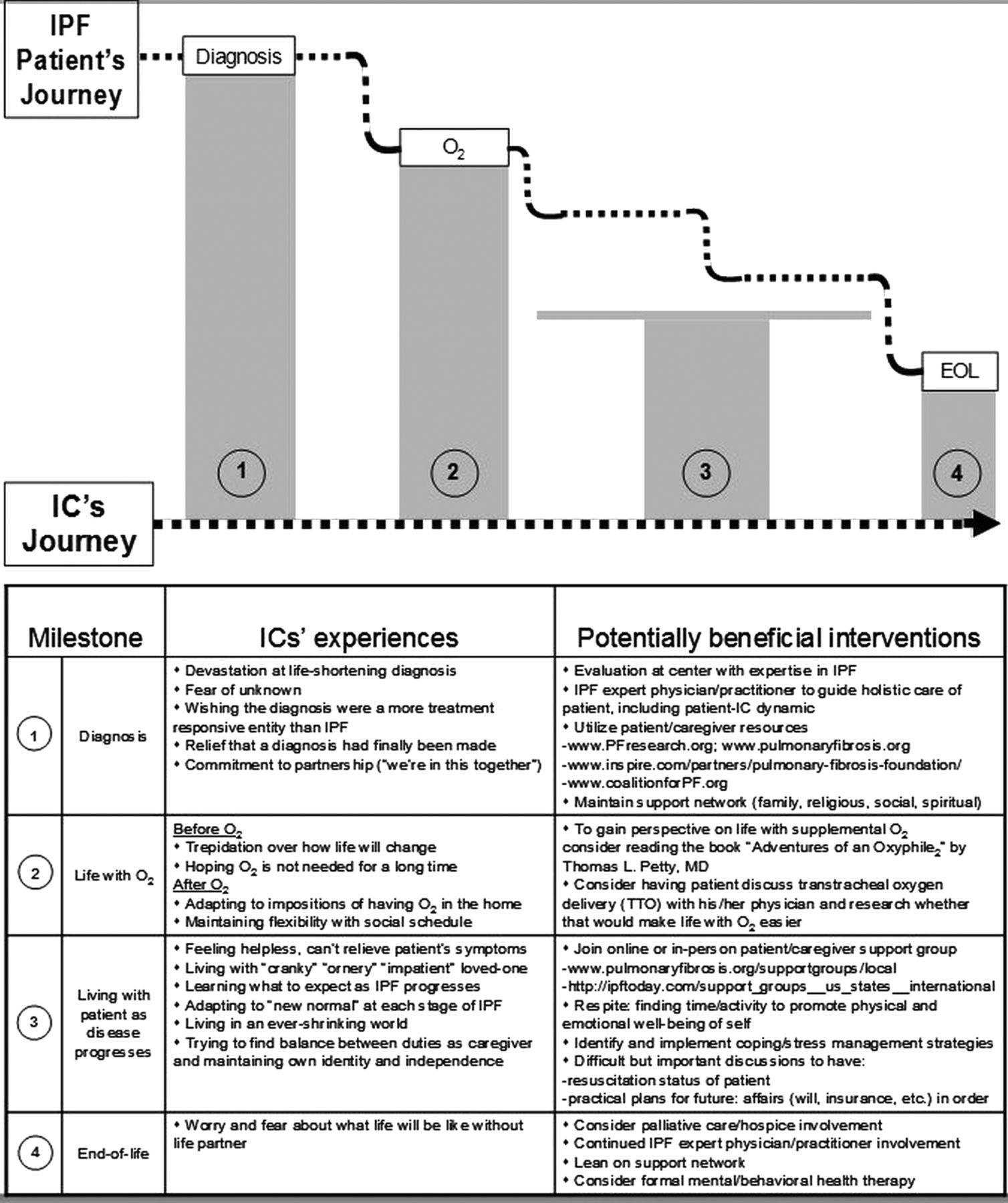
Figure 1 displays a conceptual framework for understanding the challenges and hurdles faced by ICs of patients with IPF. The ‘Potentially beneficial interventions’ are based on opinion and experience, not distillations of the data from this study.
Figure 1
View larger version:
Figure 1
Conceptual framework for person's journey as IC to IPF patient-loved one. IC, informal caregiver; IPF, idiopathic pulmonary fibrosis; O2, supplemental oxygen.

Discussion

We conducted focus groups with ICs of patients with IPF to achieve two goals: (1) to better understand the challenges of being an IC to a patient with IPF and (2) to examine how ICs perceive the impact of IPF on their patient-partners. To our knowledge, this is only the second study to examine the perspectives of ICs of patients with IPF, the only study in which FGs were used and the first using data from US ICs.
The ICs in this study perceived shortness of breath, cough and fatigue/low stamina to be the most troubling of patients’ IPF symptoms. These symptoms led to significant limitations in patients’ physical activity. In their study, performed in the UK, Bajwah et al12 performed in-depth interviews with eight patients and four ICs of advanced patients with IPF as a first step to developing an end-of-life intervention for fibrosing ILD patients and their ICs. All participants identified patients’ breathlessness as the ‘overwhelming symptom.’ Most of their patient-subjects also reported cough as a prominent symptom, and three reported sleep disturbance. Only one of their patient-subjects reported fatigue, whereas the ICs in our study repeatedly mentioned tiredness/fatigue/low stamina as an intrusive symptom for their partners. Whether there are phenotypic differences between patients with IPF in the UK and the USA, whether there is a difference in the perception of fatigue by ICs of patients with IPF in the UK versus the USA, or whether differences in study design account for the discrepancy is unclear.
What is clear—and apparent from ICs in both Bajwah et al's12 study and ours—is that patients with IPF are frustrated by their inability to escape the weight of their illness, and ICs bear the brunt of that frustration when patients (understandably) ‘get nasty,’ ‘cranky’ or ‘impatient.’ The ICs in our study also saw fear in their loved ones and observed that while this fear manifested for a few as an all-consuming focus on the disease, many patients used denial to cope with this life shortening, unpredictable illness. Both responses caused further distress for ICs.
A central issue in our study, but one that was not reported on in Bajwah and her coinvestigators’ manuscript, was O2. The ICs of patients who had not yet been prescribed O2 viewed it forebodingly and, like their patient-partners, as an unwelcome milestone of disease progression and a significant impediment to a carefree lifestyle (for themselves and their partners). The ICs of patients who were using O2 saw their loved ones turn up their O2 flow rate on ‘bad’ days to try to get relief from increased shortness of breath. Of course, the perceived benefits of O2 are not unique to patients with IPF. In a study conducted by Goldbart et al13 that focused on perspectives of patients with COPD and their ICs, patients perceived beneficial effects of O2 that included increased physical activity, confidence and independence, and ICs perceived that O2 led to improved QOL in their patient-loved ones. In our study, ICs comments on O2 were predominantly negative: they saw their patient-loved ones tethered to their O2sources, unable—or more often, unwilling—to stray far from home or for too long a time. Their comments likely stemmed from their perceptions of how O2 imposed adjustments to—and limitations on—their own physical and social activities. Supplemental O2 had the effect of shrinking both patients’ and ICs’ worlds, thus validating the concerns of ICs whose loved ones had not yet been prescribed O2. As Cullen and Stiffler14 have described, patients with chronic respiratory conditions must “negotiate lifestyle interference and physical restrictions” caused by O2. In many ways, not only the patient but the entire household must negotiate the interference and restrictions of O2; it became clear in our study that ICs must also ‘adapt oxygen to life's circumstances’ and figure out how to ‘live in a restricted world.’14
For ICs, there was an emotional cost to living in this restricted world: ours expressed disbelief and devastation at finding out their life partner had an untreatable disease; anger at the overall situation; helplessness because of their inability to relieve their spouses’ suffering; fear of the inevitable progression of IPF; and sadness knowing that their partner may live only a few more years (or months). In some cases, the emotional weight on ICs manifested as resentment towards patients.
These findings are not unique to ICs of patients with IPF: Garlo et al15 remind us that people caring for adults with chronic conditions—cancer, heart failure, COPD—experience similar burdens regardless of the patient's illness or disability. How much strain or burden an IC experiences—and the extent to which these negatively impact the physical and emotional well-being of an IC—depends on a number of IC and patient-loved one-related factors, and the complex interplay among them.15 ,16 Female ICs appear to experience greater burden than male ICs, even when providing a similar level of care.17 ,18 An IC's or patient's psychological state by and large predicts his own QOL; however, psychological distress in an IC will negatively impact a patient's QOL and vice versa.19 And it gets even more complex: when a female IC perceives that she is experiencing vastly more emotional stress over the situation than her male patient-spouse, she may sense emotional abandonment. The same is not true for male ICs.18
As we observed in our study, ICs (and other family members) of patients with terminal illnesses make significant life changes and sacrifices to care for their patient-loved ones.20 How great those changes and sacrifices need to be, and particularly how well they are accepted and the ease with which they are integrated into an IC's lifestyle, are factors that impact IC strain. Indeed, a growing cache of data suggest that an IC's psychological response to his role as caregiver—rather than the number or difficulty of the tasks they perform to care for their patient-loved one—is a major determinant of IC strain.15 Strain creates emotional distress, impairs physical functioning and decreases social contacts among ICs16; moreover, IC strain or burden predicts increased distress in patient-loved ones.21
ICs are at risk for anxiety and depression; this partly depends on the severity of disease in patient-loved ones, but it also depends on ICs’ own physical health states.22 ICs with physical ailments—as may occur in the typically older-than-middle-aged group of ICs who care for patients with IPF—are at increased risk for mood disturbance.22 Not surprisingly, IC anxiety and depression are linked to ICs’ perceptions of strain and burden.
Patient-loved one-factors also affect IC strain or burden. Breathlessness is a particularly distressing symptom for ICs to deal with,23 ,24 and has been linked to impaired QOL among ICs of patients with cancer or COPD.25 In agreement with Malik et al,24 our data revealed that a patient's struggle to breathe causes in ICs “limitations to shared activities and social life, a loss of companionship, increased feelings of responsibility and helplessness because of their inability to control their loved ones’ breathlessness.”
This study has limitations. All ICs were partners of patients evaluated at our centre, a quaternary referral centre, and only one was a man; thus, we must consider the possibility that the views of the ICs we enrolled are not fully representative of ICs of patients with IPF in the general population. However, in this largest sample of ICs of patients with IPF ever studied, the external validity of results is supported by the finding that the themes we uncovered overlapped with those from a study published previously.12 Importantly, new themes, not reported by other investigators, also emerged from our sample. We did not set out to determine the needs of ICs to develop an intervention for them, per se, although clearly they have needs that are unmet. In our conceptual framework, we describe interventions that may address some of those needs, but this is an area ripe for additional research. In a recently published manuscript, Byrne et al26described a protocol for a study aimed at developing a strategy for providing palliative care for patients with IPF and their ICs. The results of that study are eagerly anticipated and will likely prove extremely helpful for ICs of patients with this devastating disease.
In summary, we conducted focus groups with ICs of patients with IPF and learned from them that patients with IPF struggle to find the balance between desperately wanting to live a normal, active life—to maintain their independence—and yielding to a disease that forces them to rely on supplemental oxygen as well as on their ICs’ emotional and, often, physical support. Meanwhile, ICs struggle to find balance between providing that support and maintaining their own emotional and physical well-being, freedom and identity. Our suggestions for easing this struggle include establishing IC support groups as a standardised component of care; ensuring that ICs have access to respite so they have time to recharge and maintain their own physical and emotional health; developing an IPF IC-specific educational curriculum that covers topics such as symptoms to expect, how to handle new symptoms/stages of the disease, coping, etc; and encouraging ICs to develop and maintain a support network. We suspect interventions like these would prevent ICs from feeling isolated and overwhelmed, while fostering development of a more confident, competent and informed caregiver.

Footnotes

  • Contributors JJS and AB participated in study conceptualisation. AB participated in data collection. KA, AB and JJS participated in data analysis, manuscript preparation, manuscript editing and approval of the final manuscript.
  • Funding This study was supported in part by an unrestricted, investigator-initiated grant from Intermune (JJS is the recipient).
  • Competing interests JJS is supported in part by a Career Development Award from the NIH (K23 HL092227).
  • Ethics approval This study was approved by the National Jewish Health Institutional Review Board (Protocol # HS 2643), and all participants gave signed, informed consent.
  • Provenance and peer review Not commissioned; externally peer reviewed.
  • Data sharing statement No additional data are available.
This is an Open Access article distributed in accordance with the Creative Commons Attribution Non Commercial (CC BY-NC 3.0) license, which permits others to distribute, remix, adapt, build upon this work non-commercially, and license their derivative works on different terms, provided the original work is properly cited and the use is non-commercial. See: http://creativecommons.org/licenses/by-nc/3.0/

References

  1.    
  2.  
  3.  
  4.    
  5.    
  6.    
  7.    
  8.    
  9.    
  10.    
  11.    
  12.    
  13.  
  14.    
  15.    
  16.    
  17.    
  18.    
  19.    
  20.    
  21.    
  22.    
  23.  
  24.  
  25.    
  26.